

Hey there! As a supplier of SWA (Steel Wire Armoured) cables, I often get asked about the characteristic impedance of these cables. So, I thought I'd take some time to break it down and share what it means, why it matters, and how it relates to our SWA cable offerings.
First off, let's talk about what characteristic impedance actually is. In simple terms, characteristic impedance is the ratio of the voltage to the current in an electromagnetic wave traveling along a transmission line, like our SWA cables. It's a fundamental property of the cable that depends on its physical structure and the materials used in its construction.
For SWA cables, the characteristic impedance is typically around 50 or 75 ohms, depending on the specific design and application. These values are standardized in the industry because they offer a good balance between signal transmission efficiency and power handling capabilities.
Why does characteristic impedance matter? Well, when you're sending electrical signals through a cable, you want to make sure that the impedance of the source (the device sending the signal), the cable itself, and the load (the device receiving the signal) are all matched. If there's a mismatch, some of the signal will be reflected back towards the source instead of being transmitted to the load. This can cause all sorts of problems, like signal loss, distortion, and interference.
Let's say you're using an SWA cable to connect a high - speed data source to a receiver. If the impedance of the cable doesn't match that of the source and the load, you might end up with a lot of data errors. That's why it's crucial to choose an SWA cable with the right characteristic impedance for your application.
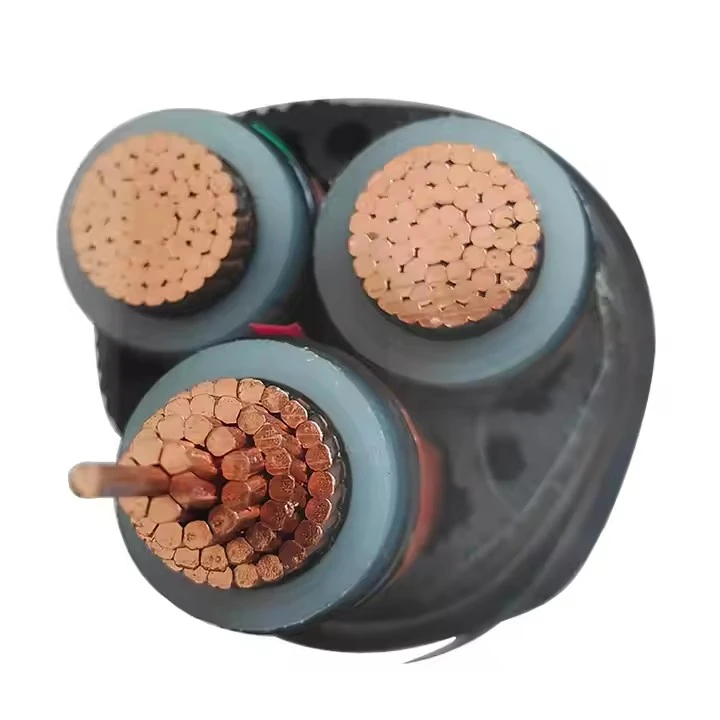
Now, let's dive into how the construction of SWA cables affects their characteristic impedance. The SWA cable consists of several layers. At the center, there's the conductor, which is usually made of copper or aluminum. The conductor's size and material can have an impact on the impedance. A larger conductor generally has lower resistance, which can change the impedance value.
Surrounding the conductor is the insulation layer. The type of insulation material and its thickness play a significant role in determining the characteristic impedance. Different insulation materials have different dielectric constants, which affect how the electric field is distributed within the cable. For example, a cable with a high - dielectric - constant insulation will have a lower characteristic impedance compared to one with a low - dielectric - constant insulation.
The steel wire armor is another important part of the SWA cable. It provides mechanical protection and also affects the cable's electrical properties. The armor can act as a shield, reducing electromagnetic interference. However, it can also influence the characteristic impedance, especially if it's not properly designed or grounded.
As a supplier, we offer a wide range of SWA cables with different characteristic impedances to meet various customer needs. Whether you're looking for a cable for a low - frequency power application or a high - speed data transmission system, we've got you covered.
If you're in the market for cables with special features, we also have some great options. Check out our Thermoplastic High Heat - resistant Nylon - coated Construction Line. This line of cables is designed to withstand high temperatures, making them ideal for harsh industrial environments.
For high - voltage applications, our High Voltage Power Cable is a top choice. These cables are engineered to handle large amounts of power safely and efficiently, with the right characteristic impedance to ensure reliable signal and power transmission.
And if you're involved in the mining industry, our Mining Rubber Sheathed Cable is specifically designed to meet the tough requirements of underground mining operations. They have excellent mechanical and electrical properties, including well - defined characteristic impedance.
When it comes to choosing the right SWA cable, it's not just about the characteristic impedance. You also need to consider other factors like the cable's voltage rating, current - carrying capacity, and environmental conditions. But understanding the characteristic impedance is a great starting point.

If you're unsure which SWA cable is right for your project, our team of experts is here to help. We can provide you with detailed technical information and advice to ensure that you make the best choice. Whether you're a small business owner or part of a large industrial project, we're committed to providing you with high - quality cables at competitive prices.
So, if you're interested in learning more about our SWA cables or have any questions about characteristic impedance, don't hesitate to reach out. We're always happy to have a chat and discuss your specific requirements. Let's work together to find the perfect cable solution for your needs.
References
- "Electromagnetic Fields and Waves" by David K. Cheng
- "Transmission Line Theory and Applications" by John F. White
- Industry standards and specifications for SWA cables from relevant electrical engineering organizations